Atlas: ‘The time is now and Ukraine is the place’
Programming director Vlad Yaremchuk talks the Kyiv festival's defiant return – and delivers a message to international artists and agents
By IQ on 18 Aug 2025
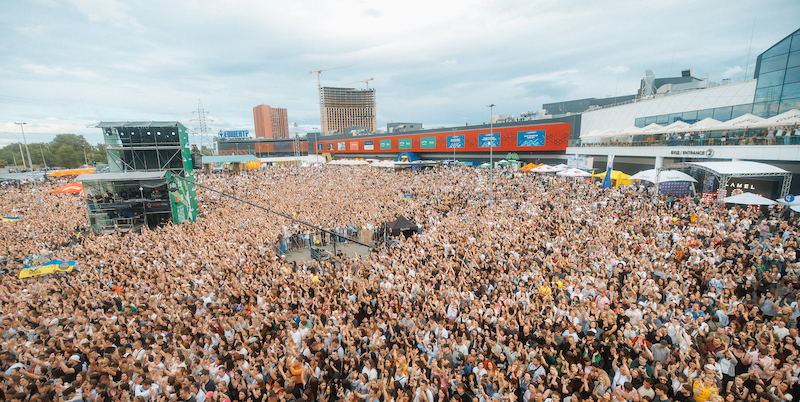
Atlas Festival 2025
Atlas Festival’s Vlad Yaremchuk has made a heartfelt plea for more international acts to come to Ukraine after successfully delivering the event’s second edition since the Russian invasion.
The 25,000-cap fundraising festival’s latest iteration took place at Kyiv’s Blockbuster Hall in July, having returned in 2024 after three years away.
Finnish rock band The Rasmus were one of the star turns at last month’s event, and programming director Yaremchuk is pitching for other overseas artists to follow suit next year.
“If an artist wants to do something truly special and meaningful, the time is now and Ukraine is the place,” he tells IQ. “Atlas Festival 2025 this July was our second wartime festival and it once again demonstrated the incredibly important role music and live events play in our lives, especially in the dire circumstances that we are facing in Ukraine at the moment. We have the privilege of holding events and we ensure that they are safe to visit and that they make a real difference.
“An international artist’s role in this equation cannot be understated. Whenever an international artist comes here, they give us hope and relief, they make us feel heard and seen and it gives us the means to keep on going when the daily reality is really dragging us down. It is not just a symbolic gesture either – we make sure this has real-life impact by doing fundraising and literally helping to save hundreds and thousands of lives here, while also raising awareness across the world.”
“2025 has been a brutal year, there is no need to sugarcoat it”
With Ukrainian president Volodymyr Zelensky set for crunch talks with Donald Trump today as European leaders descend upon the White House, here, Yaremchuk spells out the situation in his country – and how the music industry can help…
How would you describe day-to-day life in Ukraine right now?
“2025 has been a brutal year, there is no need to sugarcoat it. And this year I think it’s not just us Ukrainians that can fully feel it, the turning tides can be felt in the US, across the European continent and elsewhere much better than in the years prior. I hope that can give people at least some perspective of how it is like being at the very edge of it multiplied by constant tragedy, explosions, missiles and drones.
“This year we’ve had overnight attacks with as many drones and missiles as we would have for an entire month in the years before. As I’m writing this, I’m getting real time notifications about Russian ballistic missiles hitting multiple cities in Ukraine at the same time, while drones are creeping through. Sleepless nights spent in shelter. Sleep deprivation due to constant nightly attacks. Exhaustion from both attacks and the news, which bring anxiety, but no resolution.
“None of that compares to what people living near the frontline experience or those who live on occupied territories. Yet at the same time, I feel like Ukraine gets a lot less attention than it used to. Yes, we are still on the news, but that does not surprise people and they stopped having a good idea of what is actually going on here for a while now. So this year also feels increasingly isolated, which is the reason why every time we get someone to come here we feel relief, because we pierce that barrier and we feel real connection with someone from outside again.
“This war was too much to comprehend when it started, now there’s such an immense mass of horrifying things that already happened, are happening and will continue happening, that it would be silly of me to expect that someone will be able to understand it without experiencing it. It’s human nature, it’s normal, but it makes fighting our always-increasing isolation more difficult.”
“No one wrote a manual on how to do a festival during wartime, so we had to figure all of that out for the first time”
You staged Atlas last year for the first time since 2021, how was that possible given the circumstances?
“You can say that in 2024 we were diving into the unknown. No one wrote a manual on how to do a festival during wartime, so we had to figure all of that out for the first time. Back then, we started work on the festival in March as well and announced in the beginning of June, when the festival itself was in July, which was already crazy on its own. It was quite a gamble – other festivals happened at that point in Ukraine, but this was the biggest, with the widest audience, so inevitably there was a lot of discourse over whether it is okay to do, whether it really is safe enough and many more such questions.
“We went for it back then because we accumulated enough experience and knowledge doing smaller events during wartime. We also had our sponsors and partners onboard and found a venue – Blockbuster Mall – which enabled us to have a 25,000-capacity festival with immediate evacuation. We also decided to shoot for the stars and set a goal of raising UAH100m (€2.3m) for the country’s defence so that the festival actually contributes to the country in a meaningful way.
“The festival was set for 12-14 July. On Monday, 8 July, Russia attacked Kyiv with a cruise missile barrage targeting Okhmatdyt Children’s Hospital and residential buildings. We had to focus on helping and we were already raising money for Okhmatdyt before the strike. We could legally proceed with the festival, but that would be clearly wrong. So we managed a miracle and moved the whole festival by one week – it happened on 17-19 July and we managed to preserve almost the entire line-up, including the international headliner – Sharon Den Adel from Within Temptation. We also successfully hit our fundraising target two days after the festival.”
When did plans start coming together for the 2025 edition?
“Despite the festival’s success, we could not afford to start work on the next edition immediately and things were looking rough in general. In autumn we were unsure if we could go on at all. Luckily, by the end of the year we managed to pull things together and work on Atlas Festival 2025 started in early January, giving us much-needed two extra months of preparation compared to last year. Did it make things easier for us? Absolutely not, as that is still too tight of a deadline for a festival like that. But it gave us time and space to iterate on and improve every major aspect of the festival, while addressing all the shortcomings of the previous year. This also meant we could start selling, advertising and announcing acts earlier, which was a game-changer.
“We kept our UAH100m fundraising target, which would be more difficult to hit compared to 2024, as each year people have less money to spend and donate here. We created an entire charity department to push our fundraising mission to the next level and they’ve done an incredible job.”
“International booking still remained a huge challenge and a very personal one for me”
How did the organisation of the event compare with the previous year?
“Booking was both easier and harder. Keeping your lineup interesting year-to-year here is quite a challenge, since all the festivals pick from the same local pool of artists, yet we managed to deliver a unique enough lineup with quite a few surprises. At the same time, we could assemble a much stronger lineup and had more choice since we started booking earlier and artists were expecting the festival to happen, so they were planning their moves accordingly, compared to last year.
“International booking, though, still remained a huge challenge and a very personal one for me. Hundreds of emails, dozens of conversations, many great exchanges which would sadly not lead anywhere. Challenges are plenty – many are not ready to come to a country during the war or their loved ones are completely against it, later conversations, scheduling issues, difficult logistics, etc.
“In the end we had The Rasmus confirmed and another big act, who sadly had to cancel later in the process. The Rasmus, though, were ready to overcome all the challenges together with us in order to play on our stage, see Ukraine once again after a long pause and complete an important humanitarian mission together with us – to help the Okhmatdyt Hospital. That was a big win for the festival and a special little victory for myself.”
What were the biggest logistical challenges and how were you able to overcome them?
“Our biggest challenge in 2025 came in the form of an air raid alarm and our first real evacuation of the festival, which took place at 7.34pm on the first day of the festival, during a main stage headliner performance. In 2024, we were lucky enough to not have a single alarm during the festival, so until this moment, our whole plan was very robust, but it was still just theory, though supported by evacuation drills and experience. This was the real deal.
“Ultimately, we managed a successful evacuation, no one was hurt and our plan worked, but we also saw the human factor at play as well as all the weak spots, so we had a huge meeting the very next morning already making changes to our algorithm to address all the new challenges and shortcomings that came to light. It is a relief of sorts as now we know much better what we are dealing with and by next year’s festival we can be even more prepared than we already were.”
“The live music scene here is stunning. But it needs increasingly more help and attention from the rest of the world to survive through this war”
Outside of Atlas Festival, what sort of wider live music scene exists in Ukraine at the moment?
“It’s all quite absurd, as there are incredible things happening here every single day. So much young talent, tons of fresh new music. Ukrainian theatre is on the rise. Okean Elzy sold out five Palaces of Sports in Autumn, effectively selling 50,000 tickets. Many other acts are selling that 10k venue out, others sell out smaller ones. We are now in charge of one of Kyiv’s most iconic venues – International Center of Culture and Arts, which is a wonderful seated venue in the heart of Kyiv and it’s almost fully booked out into the next year. Our Atlas club is hosting great shows and while the sun is out we run shows on terraces of malls that give a great view of the city.
“People cling to culture here and it’s more honest than it ever was. The fact that people even wake up after a god knows which attack this month and go on to do their job or create art or help others is a daily miracle that’s plentiful here.
We were talking a lot about the music boom or a cultural revolution happening in 2022 and 2023 here. That’s all still true and Ukrainian music is looking greater than it ever did, but the adrenaline is running out and we are all on a kind of survival marathon here.
“Playing outside of the country is a privilege that is ever more rare, so those artists who stay in Ukraine fade away from the international radar even more. Sure, an act can come play a showcase festival, but they won’t be able to easily follow it up by a few festivals or a tour. People are simply exhausted and there is not much money around to sustain a good career, yet most still manage, despite everything.
“It brings me so much joy to see how young artists who started or really kicked their career of post-2022 are preparing for their first Atlas Festival performance as for a lot of them it’s their biggest stage to date.I want all of them to thrive, they deserve it at least due to the sheer effort they have to put in to keep going amidst the craziness. So I hope the rest of the world also wants them to succeed and can help by booking those who can be booked, highlighting them, mentoring them or by interacting and collaborating with them otherwise.
“The live music scene here is stunning. But it needs increasingly more help and attention from the rest of the world to survive through this war.”
“Atlas Festival 2026 will take place on 17-19 July and I invite you to think whether you and your artists are willing to get involved”
Lastly, do you have a message for the international live business?
“The message is simple – we appreciate all the kind words and gestures of support in Ukraine, you can’t imagine how much. But even more than that we appreciate those who follow up and come here to visit, play, talk to us and witness what we are going through. We make those rare visits count.
“This year we can afford to already discuss bookings for next year’s festival, something that was impossible this year and the year prior. As of now, I cannot travel out of Ukraine and, as much as I’d love to, cannot visit conferences or see agents in person, which makes things more challenging.
“Atlas Festival 2026 will take place on 17-19 July and I invite you to think whether you and your artists are willing to get involved. All we need is your initial interest and the rest we will take care of. Apart from the festival we also have great venues that work round the year and they are ready to welcome international acts as well, slotting nicely into your planned tours. If you want to have a discussion – you can always reach me at [email protected] and I will be truly grateful if you do so.”
Get more stories like this in your inbox by signing up for IQ Index, IQ’s free email digest of essential live music industry news.
